Abstract
As concerns have grown regarding harmful content spread on social media, platform mechanisms for content moderation have become increasingly significant. However, many existing platform governance structures lack formal processes for democratic participation by users of the platform. Drawing inspiration from constitutional jury trials in many legal systems, this paper proposes digital juries as a civics-oriented approach for adjudicating content moderation cases. Building on existing theoretical models of jury decision-making, we outline a 5-stage model characterizing the space of design considerations in a digital jury process. We implement two examples of jury designs involving blind-voting and deliberation. From users who participate in our jury implementations, we gather informed judgments of the democratic legitimacy of a jury process for content moderation. We find that digital juries are perceived as more procedurally just than existing common platform moderation practices, but also find disagreement over whether jury decisions should be enforced or used as recommendations.
They are mainly focused on implementing digital juries. While they do not provide a definition they are operationalizing, they use a 5-stage model to define the jury process: jury selection, onboarding, case trial, consensus formation, and outcome enforcement.
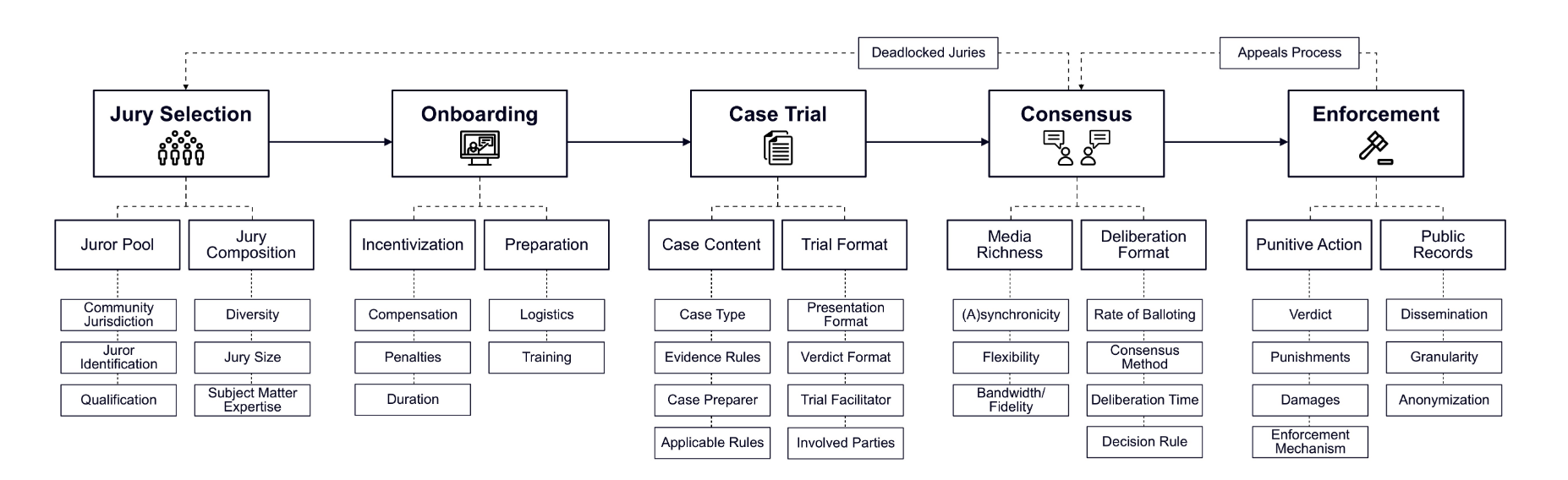
The problem space is content moderation on social media platforms, aiming to make adjudications of contested content more of a democratic process than outsourced to crowdworkers. This problem space is very well defined—how toxic is the content, and what action should we take on it?
They recruit 82 jurors to make decisions, in groups of 6. They follow the five stages above. Treatments are at the consensus stage, where they diverge in two three ways:
- Status quo: no user input from participant, users are shown platform’s decision and rationale.
- Scalable (semi-synchronous, blind-voting jury): jurors independently decide on a toxicity score and recommended action in a one-round blind vote.
- Immersive (synchronous, deliberating jury): participants are able to deliberate with other jurors in a chatroom for four minutes before submitting their vote. After the minimum deliberation time elapses, jurors are allowed to continue discussion for as long as desired, as well as freely change their vote.
They find that digital juries helped improve perceptions of process justice in five attributes: legitimacy, trust, equality, fairness, and care, but not in efficacy. (See Procedural justice)
- Participants expressed that user input lent greater legitimacy and felt empowered, contrasting with distrust in opaque automation and paid moderator processes.
- The status quo was the least preferred condition for 55% of the participants.
- Efficacy vs. trust: Users who favored the status quo cited efficacy-related issues like time efficiency and placed more trust in the expertise of paid moderators and algorithms.
I like that this study does point out the tension between efficacy/trust and process justice. There is an element of efficiency that cannot be overlooked with doing this work through either automation or platform workers. They also find that the “care” attribute was perceived as significantly greater in Immersive than Scalable.