- Enables self-representation by allowing participants to submit statements in response to an open prompt and then vote on others’ comments using options like Agree, Disagree, or Pass/Unsure.
- Uses PCA and K-means clustering to map votes into a 2-dim opinion space and identify distinct opinion groups.
- Participants who voted on fewer than 7 comments are removed to avoid “clumping up” of participants. Number is arbitrary, hyperparameter.
- Within each large clusters at K=100, algorithm further performs K-means for values of K=2~5.
- K for which silhouette coefficient (measure of within-cluster similarity and between-cluster dissimilarity) is chosen for opinion groups.
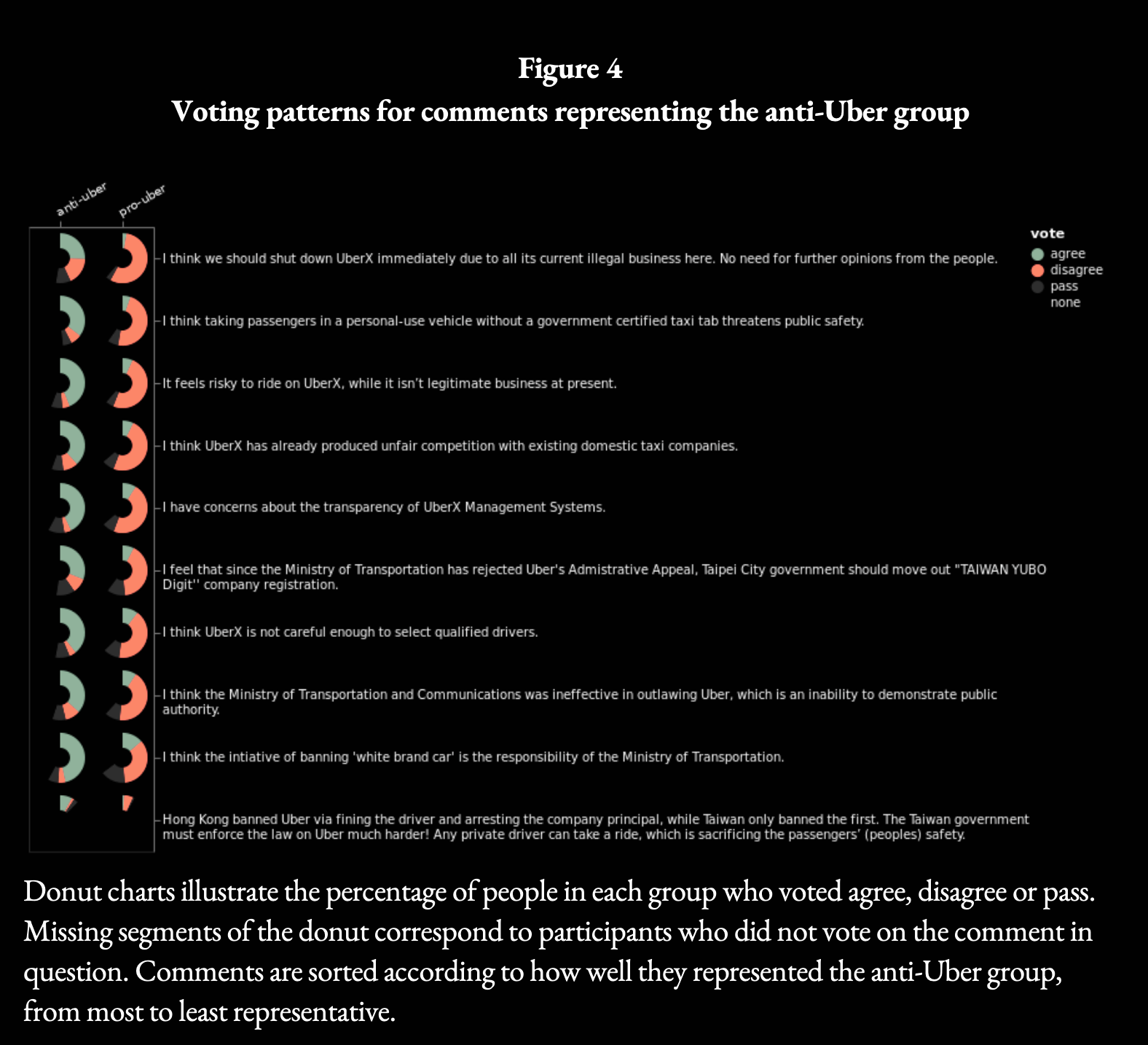
- Within each opinion group, comments that are most representative of the OG are picked by estimating how much more likely participants in group g are to vote v on said comment than those outside group g.
- The groups also inform a group-aware concensus metric, which is highest when all groups tend to agree with a comment in question. Ordering comments using this metric allows users to find points of common ground and rough consensus.
- Comments are sent to users in an order that is probabilistically weighted according to a metric which reflects how likely they are to help place participants in the opinion landscape or build consensus.
- This is done by boosting consensus and shrinks to 0 for comments with no support
- Elevating comments with a high PCA loading, placing participants in the conversation
- Focused on surfacing comments that distinguish opinion groups and identifying points of common ground.
- Polis is agnostic to language.
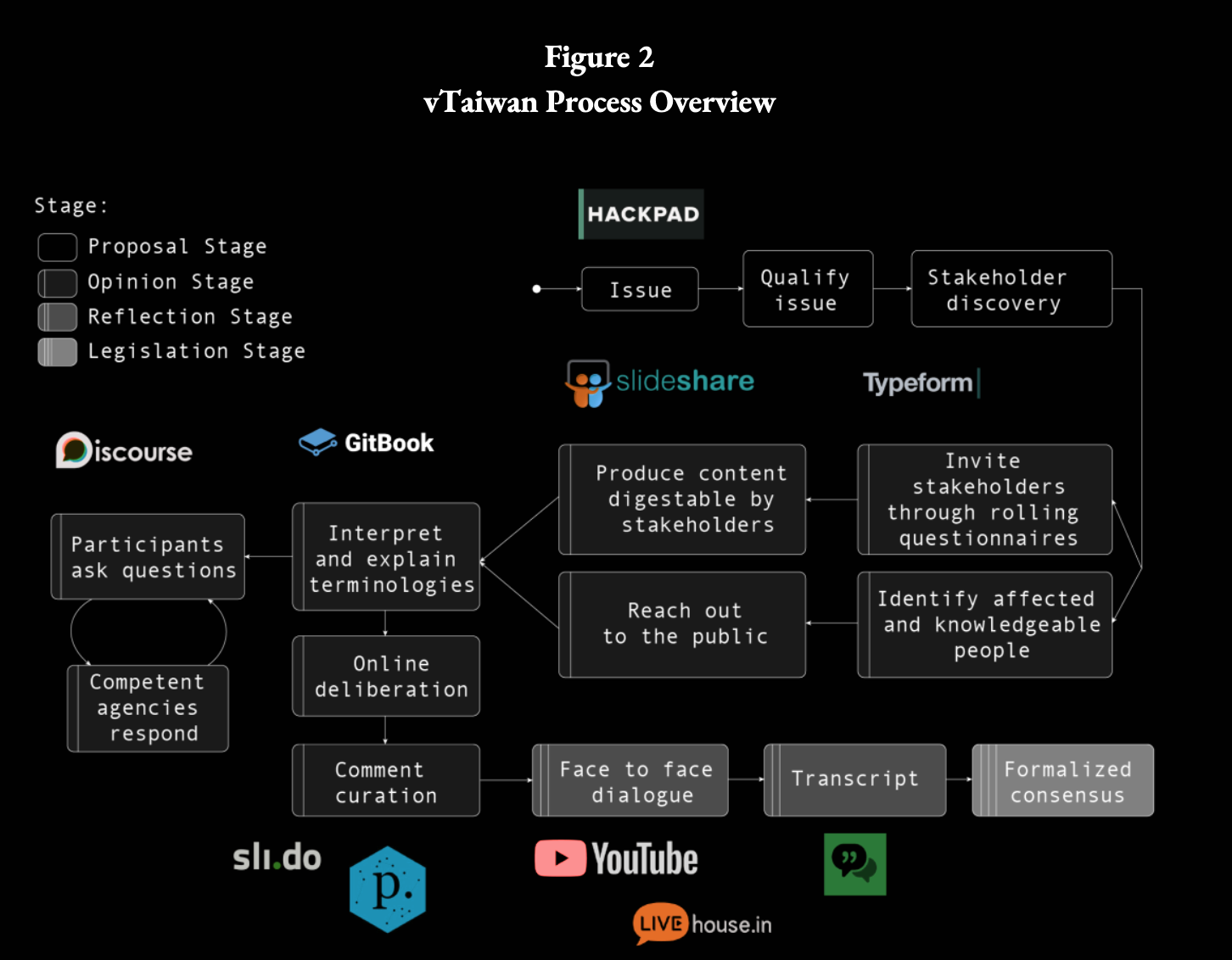
- Run as part of the vTaiwan processes examining the legality of Uber operating in the Taiwanese transportation marketplace.
- Participants were drawn from stakeholder groups (taxi/Uber drivers, citizens…), n=2000
- The first PCA component captured the variance between those in favor and those in opposition to Uber, and the second PCA captured the variances regarding regulation, independent of attitudes toward Uber.
- To interpret the results, one has to pick some “top-loading” comments from each end of the PCA component to understand what the opposing sides are characteristically.
- And the variance of the PCA components reduce as we pick lower and lower eigenvalues (i.e., less minimizing of the difference between vector and the real matrix)
- When you visualize the votes for each comment, it shows